Showing posts with label Mission Model Discussion. Show all posts

Friday, November 2, 2018

IO7: In Space No One Can Hear You Scream

Greetings FIRST LEGO League Oregon,

In today's FIRST LEGO League Oregon Update we will cover these topics:
  1. HAVE YOU PAID?
  2. Tournament Assignments Are LIVE!
  3. November Mission Model is LIVE!
  4. Software Pilot Slack Group
  5.  Tips for Picking Robot Missions
  6. Upcoming FIRST Events

Friday, September 29, 2017

HD5: Filtered Information to Get Your Team Pumped Up

Greetings FIRST LEGO League Oregon,

How to get water from a low point to a higher point in a municipal system.In this update, you will find:

  1. National Registration Open for another ~10 days!
  2. Are you ready to apply for your Qualifying Tournament?
  3. Oregon Qualifying Tournament Dates
  4. What You Need to Know About Qualifying Tournaments
  5. Bring in the Bricks - Things to Know About the Challenge Kit
  6. The Deep Dark Pit of Email

Use this link to read this update as a blog post

Tuesday, November 22, 2016

November Mission Model Discussion: M15 - ALL SAMPLES

Manure Samples
Required for Scoring: At the end of the match ALL 7 Manure Samples are in the Training and Research Area
Conditions: Conditions for M09 Apply: Only 1 Manure Sample may be Transported at a time.
Score: 5pts (in addition to points earned in M09)

Note from Oregon Head Referee Tom: An official Rule Update says there are seven Manure Samples (not twelve).

Real World Impact: Some data is good, but a complete data set allows scientist to have an accurate consistent picture on what is happening in the world. Fecal samples are a treasure trove of information waiting to be understood. With consistently, delivered samples scientists can build a timeline for change in the health of an individual animal or an entire population. Having quality information can be rare in field research making this type of collection worth more than just points in the real world.

Discussion: Because each Manure Sample must be transported one at a time this mission can be time-consuming. What strategy is your team using to efficiently deliver the Samples to the Training and Research Area?

Monday, November 21, 2016

November Mission Model Discussion: M14 - MILK ON RAMP

Ramp Model
Required for Scoring:  At the end of the match, All 3 Milk must be completely supported by the Ramp (scoring conditions vary).
Conditions: Scores have various conditions.
Score:
2pts - all 3 Milk supported by the Ramp.
3pts - all 3 Milk supported by the Ramp & are the only things touching the Ramp
4pts - all 3 Milk supported by the Ramp, are the only things touching the Ramp, & all are standing upright.
Milk Model
Note from Oregon Head Referee Tom: For Options 2 (3pts) and 3 (4pts), it is OK if the East or West edge of the Ramp is touching the Mat. The Mat does not count as a “thing”.

Real World Impact: Animal products are only useful if they can get to the people who need them. The more accurately and efficiently this process can work the better it is for the product (so it doesn’t spoil) and for the people who use it. Robots are being added to many parts of this process.

Discussion: Is the ramp a crucial access point for your team? Does putting milk on the ramp create more problems than the points are worth?

Friday, November 18, 2016

November Mission Model Discussion: M13 - MILK IN BASE

Milk Models

Required for Scoring: At the end of the match ALL three milk models are in base
Conditions: NONE
Score: 1pt

This is an all or nothing mission. 1pt is available if your team has all the milk in base.

Real World Impact: The milking barn is only the first stop for milk on it’s trip to being used by people. Collecting and transporting for refinement or further shipping is an important step in the process.

Discussion: Does your robot have a good way to consistently collect the milk from the carousel? Is one point enough to make it worth doing?

Thursday, November 17, 2016

November Mission Model Discussion: M12 - SEAL IN BASE

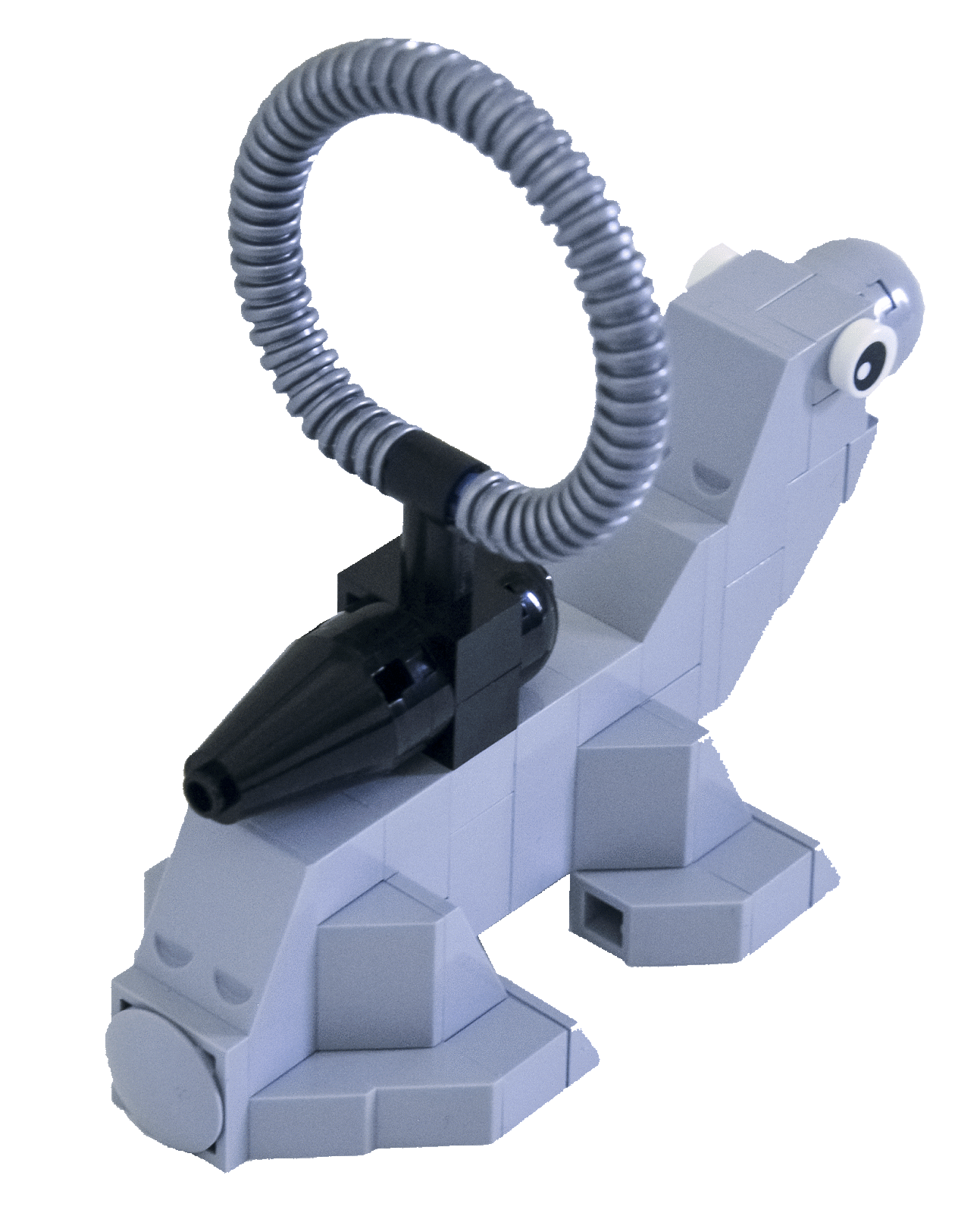
Seal Model

Required for Scoring: At the end of the match, Seal is completely in Base
Conditions: Seal can not be broken
Score: 1 pt

Real World Impact: Sometimes research animals need to be brought in after being monitored in the wild. Most often samples are collected in the field. Samples may include fur, feces, blood, scales, and a variety of measurements. If while collecting samples or retrieving monitoring hardware, like the camera or a radio collar, a problem is noticed with the animal biologists will make the call to bring the animal in. Sometimes the animals can be rehabilitated and returned to the wild. Other times, their conditions are permanent and the decision is made to introduce them to research and outreach programs. These animals often become ambassadors for the problems affecting their species.

Discussion: The seal is at the far Southeast end of the board, does the single point make this mission worth it for your team?

Wednesday, November 16, 2016

November Mission Model Discussion: M11 - PROSTHESIS

Prosthesis and Pet Model

Required for Scoring: At the end of the match the Prosthesis is fitted to the Pet (pig) OR the Prosthesis if fitted to the Pet AND the Pet is completely in the Farm Target
Conditions: NONE
Score: 9pts for the Prosthesis fitted to the Pet OR 15pts for the Prosthesis fitted to the Pet AND in the Farm Target

Real World Impact: Sometimes animals do not have the use of all of their limbs. In some cases the lives of these creatures is benefited when replacements can be created. This model shows the increased mobility and quality of life for a pet who is missing functional hind-limbs. By providing a wheeled brace the pet is now able to explore the world. Engineers face unique challenges when designing artificial limbs for animals. Animals won’t stay on smooth paths. They don’t use their limbs the same way we do. Also there are many challenges with how to attach the limbs to ensure they are comfortable as the animal uses them daily.

Discussion: What is the most challenging part of combining the Pet and the Prosthesis for your team?

Tuesday, November 15, 2016

November Mission Model Discussion: M10 - BEE KEEPING

Bee Model
Honey Model
Required for Scoring: At the end of the match the bee is on the beehive and the honey is not in the beehive or is in base.
Conditions: NONE
Score: 12pts if bee is on beehive and the honey is NOT in beehive OR 15pts if bee is on the beehive and the honey is completely in BASE

Note from Oregon Head Referee Tom: In the Challenge Guide, the caption for the picture on Page 24 “Training & Research Area” only applies to the left side of the image; the Beehive is not part of the Training and Research Area.

Beehive Model
Real World Impact: Many species of bee were recently added to the US Endangered Species Act, citing significant population decline due to human impact. One of the biggest concerns is colony collapse all of the causes of which are still not fully known, although crop monocultures, disease, and pesticide use may all be factors. At this time bees, provide the most of the crop pollination for food production. Also, bees produce honey, which most people agree is a pretty great thing. Honey in addition to being a shelf-stable sweetener, has many unique chemical properties. Beekeepers have a long history of supporting bee and local food production.

Discussion: Will your team pick up the bee to place on the hive? Do you collect the honey after you do this?

Monday, November 14, 2016

November Mission Model Discussion: M09 - TRAINING AND RESEARCH

Trainer & Dog Model

Zoologist Model
Required for Scoring: At the end of the match, the Dog & Trainer model, The Zoologist, and/or Manure Samples are completely in the Training & Research Area.
Conditions: Only one Manure Sample may be Transported at a time.
Score: 15 pts for the Zoologist, 12 pts for the Dog & Trainer, 5 pts for each Manure sample up to 7 samples.

There is no additional condition for transporting the Zoologist and the Dog & Trainer Models.

Important Updates: Update 5 MO9 clarifies that Manure Samples transported correctly will still count even if some Manure is not transported correctly.
Update 1 corrects the total number of Manure Samples from 12 to 7, as 5 will be used as penalty markers by the referees. Penalty markers can not be moved by the team.

Note from Oregon Head Referee Tom: For purposes of Transporting (D10) the Manure Samples, “contact” includes indirect contact. If A touches B, and B touches C, then A is touching C.

Manure Sample Models
For example, if the Robot moves multiple Manure Samples to the Training and Research Area by using a container, the “More” rule for M09 is not met (because the Robot was in indirect Contact with multiple samples while Transporting them).

The “More” rule for M09 applies whenever a Manure Sample is being Transported – not just between Base and the Training and Research Area.

Real World Impact: Trainers not only work closely with their animals, however; they are also responsible for monitoring their health. Zoologists fill a large variety of roles each day. Sometimes they work directly with animals, sometimes they are collecting fecal or hair samples, and sometimes they are doing analysis on information collected. Fecal samples and manure are a tremendous resource and challenge when dealing with animals. It’s important that samples are not contaminated before analysis is done. It is also very important that the researchers stay safe while working with feces. Many diseases can be spread through fecal contact, especially from animals that eat meat, like members of the dog family.

Discussion: These missions are going to involve a lot of robot navigating, with a ramp in front of the Training Area, a Zoologist to collect, and Manure Samples scattered and needing to be transported individually. When in the 2.5 minute run does your team think is the best time to work on these challenges?

Friday, November 11, 2016

November Mission Model Discussion: M08 - CAMERA RECOVERY

Seal with Camera Model

Camera Model
Required for Scoring: At the end of the match the camera is completely in BASE
Conditions: NONE
Score: 15pts
This mission requires the camera resting on the back of the seal to be moved to base by the robot.
Real World Impact: First developed by National Geographic, Critter Cam has opened an entirely new
way to research how species use their environments. Prior to critter cam, researchers had to record chance observations, set camera traps, or tag animals and track them using techniques like radio telemetry. While these systems were good at showing what habitat was used, where animals moved, and how many of a species may be present it was hard to see habitat use in action. With cameras mounted on animals big enough to carry them, more natural behaviors can be watched once the camera is recovered. Now scientists can see how the animals use their habitat and what importance different plants and structures have for them. Especially animals like seals who travel where we can not easily follow.
Discussion: It’s a long way to the beach to get the camera. What route is your team taking across the board?

Thursday, November 10, 2016

November Mission Model Discussion: M07 - PANDA RELEASE

Panda Release Model

Required for Scoring: At the END OF THE MATCH, the slider looks fully open clockwise.
Conditions: NONE
Score: 10pts

The challenge here is for the robot to release the pandas, by sliding one-half of the model in a clockwise fashion without damaging the model. This model is very flat to the mat.

Real World Impact: Pandas are solitary animals rarely coming into contact with one another in the wild. Their population significantly benefits from breeding programs, especially those outside Chengdu in Sichuan Province, China. Pandas are not the only species to be helped in this way. Just a few decades ago the California Condor was brought back from 9 individuals, all of which were brought into captivity to a wild population of 248 individuals last year, (over 400 if you count captive birds). While in captivity in addition to health monitoring and breeding programs animals can have a profound educational impact on the people who share a community with them.

Discussion: This model is very fragile, how does your team keep their robot from damaging it during missions?

Wednesday, November 9, 2016

November Mission Model Discussion: M06 - MILKING AUTOMATION

Milking Automation Model

Required for Scoring: Visible at the end of the match, the milk has rolled out of the model and/or the manure has rolled out of the model
Conditions: The robot must move the red lever to release the milk and/or manure.
Score: 15 pts for Milk AND Manure released from all rolled out of model. 20 pts if all milk, but no manure roll out of the model.

This model has an opportunity for line following along a curve. It also requires one cow to be pushed into the model before rotational movement begins.

Note from Oregon Head Referee Tom: The lower point value is given if all three milk and any manure roll out. The higher point value is given if all three milk and no manure roll out.

Real World Impact: Dairies have been a part of human settlements for so long that no one knows when they began. Cows must be milked twice a day during milk production or they can suffer from serious health issues. Many cows are trained to walk into the milking systems, like the one the carousel represents. In a real life carousel the cows eat while being milked on and the machinery rotate them through the milking barn. This gives all cows a chance to come in get milked, and be back out and on their way into the pasture with the least walking on hard concrete. Manure is collected by grates on the floor making the system easy to wash and keep clean.

Discussion: This model has been very popular at demonstration events in Oregon. What other missions is your robot doing while they milk cows?

Tuesday, November 8, 2016

November Mission Model Discussion: M05 - BIOMIMICRY

Biomimicry Wall

Required for Scoring: The Biomimicry Wall entirely supports the White Gecko and/or the team’s robot.
Conditions: No part of the white gecko or the robot may be in contact with ANYTHING other than the Biomimicry Wall and/or the green gecko. EXCEPTION: two scoring objects (robot and white gecko) may be in contact with each other.
Score: White Gecko: 15pts Robot: 32pts

White Gecko
Note from Oregon Head Referee Tom: During the 2.5 minute Match, Interrupting the Robot while the Wall is supporting the Robot’s weight will result in an “Interruption” penalty and the loss of any Transported Objects (R15). The Interrupted Robot can be left on the Wall, but these penalties will apply.

Usually, the Refs allow a team to turn off their robot during a Match without penalty (to save battery power) if they are not attempting any additional missions. But the duration of M05 includes “visible at the end of the match”, so there is no free Robot turn-off for M05.

Real World Impact: Animals can do some pretty remarkable stuff. They have the biological technology to overcome many challenges. The gecko, in particular, has been an inspiration for many innovations because of their ability to climb smooth surfaces. Engineers also are inspired by the flight mechanics of insects and birds. Engineers study these animals carefully and utilize their unique biology in to create new mechanical abilities for humans to use in our homes, fields, and research.

Discussion: Has an animal inspired the way your team will complete this mission or any other mission?

Monday, November 7, 2016

November Mission Model Discussion: M04 - FEEDING

Refrigerator Model

Required for Scoring: At the end of the match, A piece of food from the refrigerator model is completely in the target area.
Conditions: If multiple pieces of food are in a target area, the color must match. Clarification from UPDATE 5: If multiple pieces of food are in a target area, but are not alike, only that target area does not count for points. Other target areas can still be considered.
Score: 10pts for each food

Food must be collected from the refrigerator to attempt this mission. There are no additional points for getting the food out of the refrigerator. From that point the robot needs to distribute food to the animals, being mindful that multiple pieces of food in a target area match in color. In the video, it is hinted that using a color sensor could help with this.

Real World Impact: Feeding wild animals isn’t as simple as feeding your dog or cat. Animals have particular diets that correspond to the foods native to their home environment. Getting those foods, or ones with similar nutritional and digestibility to the native foods can be a challenge. Many of these food items need to be stored at specific temperatures, or spoil easily. Some need to come with their own food source or attached to larger plants to be picked by the animal. Managing the diets for multiple species such as at a zoo, aquarium, or rehabilitation center is extra challenging.

Discussion: How does your team determine which animal receives which food?

Friday, November 4, 2016

November Mission Model Discussion: M03 - ANIMAL CONSERVATION

Animal Conservation Mission Model

Required for Scoring: Visible at the end of the match, Two identical animals are completely on the same side.
Conditions: Each pair must be created by rotating the Animal Conservation Mission Model
Score: 20pts per identical pair for both teams!

Frogs
Before the match starts, each team may select one of the animal models; Gorilla, Bat, Flamingo, Frogs, or Reindeer to trade with the adjacent team. It is recommended that teams decide which models to exchange before the start of the match. If your team can not reach the Animal Conservation Mission Model your referee will be glad to help place your starting model. Update 4 reminds teams that each frog meeting the scoring requirement (and conditions) will score. The frog model may be chosen at the start of the match.  If the teams use their robot to change the models on the Animal Conservation Mission Model, the referee will reset the red lever so the model may be rotated again.  
Flamingo
Models may be scored if they are on the team’s field South of the midline between the tables, in base, or in the storage area the team brings to the field. If you remove the model from the table and place it in your storage area, please make sure to return it to the referee before you leave the competition table.


Gorilla

Real World Impact: Whether it’s maintaining the genetic health of animals in captivity, moving animals for research, rehabilitation, or educational programs, there are lots of reasons to bring animals together. Some species have been revived from near extinction thanks to careful breeding programs. Other species are maintained and reinforced through collaborative breeding efforts at numerous zoos and research centers around the world. This is critically important for species that are struggling with severe habitat fragmentation in their natural habitat.

Discussion: How will your team work with the other teams to maximize the potential of this mission?

Bat

Thursday, November 3, 2016

November Mission Model Discussion: M02 - Service Dog Action

Service Dog Action Model

Required for Scoring: The warning fence is down at the end of the match
Barriers
Will be placed on either side of robot road
Conditions: The fence must be down because the team’s robot completely crossed while traveling from the west after traveling through the barriers.
Score: 15 points

Note from Oregon Head Referee Tom: 
The Robot must travel along the corridor formed by all of the Barriers, and the entire Robot must
cross the Fence from west to east.

Real World Impact: Animals have been trained to work cooperatively with people in a variety of roles. Service animals help people overcome challenges in their everyday life. In our model, the dog is helping our deaf-blind pedestrian watch for passing traffic. This is only one of many roles animals fill. Training a service animal takes years of consistent, dedicated work. Animals are carefully matched to the people they will be helping. When a service animal is working it’s full responsibility is solely to its human. It’s very important to let these animals do their job unhindered when you see them in public.

This mission looks easy, but it is not without its challenges. To be successful your robot must navigate the barriers and cross-over the LEGO fence.

Discussion: What is the biggest challenge with this mission for your team?

Wednesday, November 2, 2016

The 4 Week Countdown

Greetings FIRST LEGO League Oregon,

You can expect more frequent posts from here until the tournaments in just 4 weeks!
  1. November Mission Model Discussion
  2. Notes from Oregon Head Referee Tom Mosher
  3. OMSI & Cedar Mills Project Demonstration Days
  4. November Team Goals
  5. FIRST Tech Challenge Leagues Start this week
1) November Mission Model Discussion
Yesterday, started the November Mission Model Discussion. This annual Facebook event is also being cross-posted on the blog! Each day from November 1 through November 23 a new model or FIRST LEGO League robot rule will be discussed. Please use the discussions as part of your team meeting, or share your ideas in the comments here on the blog or on our Facebook page.  These posts will NOT be sent via email. Please follow our blog, facebook, G+ or all!

2) Notes from Oregon Head Referee Tom Mosher

Oregon Head Referee Tom Mosher would like to share the following with all teams - many of these items will also be addressed in the November Mission Model Discussion.
Greetings FLL Teams!
Here is some information you should know as you prepare your strategy for the Animal Allies robot game. References to specific rules are in parenthesis.
Note that this information is not official rules, and is subject to change by any official updates or your tournament's head referee (GP5).
General Guidance:
We prefer that Mission Models stay in Base or on a Tray with the two Technicians who are at the Table. The Team members who are not the current Technicians may hold Robot equipment, but please leave the Mission Models near the Table where the Refs can easily see them (R12).
Veteran teams should review the “Serious Changes for 2016” notes on Page 20 of the Challenge Guide. 
Teams may not store any game materials on the Mat outside of Base (R10 and R12).
Reminder: The “Interrupting” rule (R14) means that teams may only have one chance to deliver an Object from Base out to the Field.  Once the Robot is completely outside of Base, Interrupting the Robot while it is Transporting any Objects will result in all of the Objects being removed from the game. Please read and understand R14 completely.
Questions? Contact Tom Mosher (ORTOP Head Referee) at <fll.rules.or@gmail.com>
Mission Notes:
M01: Shark Shipment: The Shark and the Tank are separate Mission Models. R11 does not allow these models to be combined, other than “loose enough” that if a Model is picked up (such as the Tank), nothing else (such as the Shark) should come with it. So be very careful with any strategy that connects the Shark and Tank.
M02: Service Dog Action: The Robot must travel along the corridor formed by all of the Barriers, and the entire Robot must cross the Fence from west to east.
M05 Biomimicry: During the 2.5 minute Match, Interrupting the Robot while the Wall is supporting the Robot’s weight will result in an “Interruption” penalty and the loss of any Transported Objects (R15). The Interrupted Robot can be left on the Wall, but these penalties will apply.
Usually the Refs allow a team to turn off their robot during a Match without penalty (to save battery power) if they are not attempting any additional missions. But the duration of M05 includes “visible at the end of the match”, so there is no free Robot turn-off for M05.
M06 Milking: The lower point value is given if all three milk and any manure roll out. The higher point value is given if all three milk and no manure roll out.
M09 Training and Research: For purposes of Transporting (D10) the Manure Samples, “contact” includes indirect contact. If A touches B, and B touches C, then A is touching C.
For example, if the Robot moves multiple Manure Samples to the Training and Research Area by using a container, the “More” rule for M09 is not met (because the Robot was in indirect Contact with multiple samples while Transporting them).
The “More” rule for M09 applies whenever a Manure Sample is being Transported – not just between Base and the Training and Research Area.
M10 Bee Keeping: In the Challenge Guide, the caption for the picture on Page 24 “Training & Research Area” only applies to the left side of the image; the Beehive is not part of the Training and Research Area.
M14 Milk on Ramp: For Options 2 and 3, it is OK if the East or West edge of the Ramp is touching the Mat. The Mat does not count as a “thing”. 
M15 All Samples: An official Rule Update says there are seven Manure Samples (not twelve). 
3) OMSI & Cedar Mills Project Demonstration Days
Space is still available for teams to share their FIRST LEGO League Innovative Solution at OMSI or Cedar Mills Library.

On November 19th and December 3rd, your team can be the feature of the OMSI Lab for one hour. Your team will have the opportunity to bring in their innovative solution and any additional materials they need to share their solution with all the people attending OMSI that day. Book your 1-hour slot here. 

Cedar Mill Library also has several days they are welcoming FIRST LEGO League teams to share their Project. Teams must use the link above to register to participate on these days: Monday, November 28, 6:30 pm, Tuesday, November 29, 6:30 pm, Friday, December 2, 6:30 pm, Sunday, December 4, 1:00 pm, Monday, December 5, 6:30 pm, Tuesday, December 6, 6:30 pm, Friday, December 9, 6:30 pm.

4) November Team Goals
This month your team should be working to achieve these goals:

  • Share your Innovative Solution with an expert who can provide critical feedback to help the team refine their idea.
  • Have all of the team parents complete the STIMS form for your team, online or in print. Please see this page for help. (It is targeted at FIRST Robotics Competition, but is true for all FIRST teams). Team Rosters showing electronic consent for all team members, or Team Rosters AND FIRST OFFICIAL Youth Team Member Forms (both pages) are REQUIRED for all teams and their 3 adults at the qualifying tournament.
  • Practice your 5 minute presentation for your team's parents or your school.
  • Robot successfully runs 1 minute worth of missions without needing to interrupt the robot (pick it up).  Make sure you time it!  You can touch the robot in base of course!
  • Practice your team's public speaking by sharing FIRST LEGO League in your community, this can be as easy as talking with your class, school, or a local organization.
  • Practice your Core Values! Reach out to others in your community who could use your help, or a new team you may know about. Maybe your team struggles with a core value, find a way to practice it at each meeting this month.
  • Practice your team introduction that you will use as you walk into the judging rooms. This is a great practice to get things started. Have fun, your judging session begins the minute the door opens, so having your team practice by walking through a door is a great way to prepare! Your introduction should last no more than a few seconds, but is the first impression your judges will have of you. Keep in mind that the judging rooms will be configured differently at every event depending on the space available. This is not anything fancy, it is the same thing adults do when walking into job interviews, but for new teams, it's an unknown experience. Plus there are up to 10 team members. A great example is to line up in a particular order and have each student introduce themselves while walking or as they reach a stopping point in the room. "Hi I'm _________." The last team member adds, "and we are Team #### _______"
  • Reveiew the challenge manual and download the updates!

5) FIRST Tech Challenge Leagues Start this week
FIRST LEGO League isn't the only group of young engineers getting ready for competition. FIRST Tech Challenge League teams are beginning their League Meets this week! Every 2 weeks teams in clusters around Oregon will meet to test their robots in short competitions. Top scores from the League Meets will carry forward with the teams as they go to their Qualifying Tournaments in January. See the schedule for all FIRST Tech Challenge events in Oregon here.

FIRST Tech Challenge is a competitive robotics program for students in 7-12th grades. Teams are made of up to 15 students who work from September through February to design, build, and program a robot that will compete on a 12' x 12' game with 3 other robots. Teams are paired either the red or blue alliance in each match. This year's game is called Velocity Vortex and challenges teams to shoot wiffle ball particles into a rotatable center goal among other challenges. You can learn about the challenge here.

I highly recommend FIRST LEGO League teams attending FIRST Tech Challenge events to see the next level of the program.